Shoulder Season Travel After 50: Why Fall Beats Summer
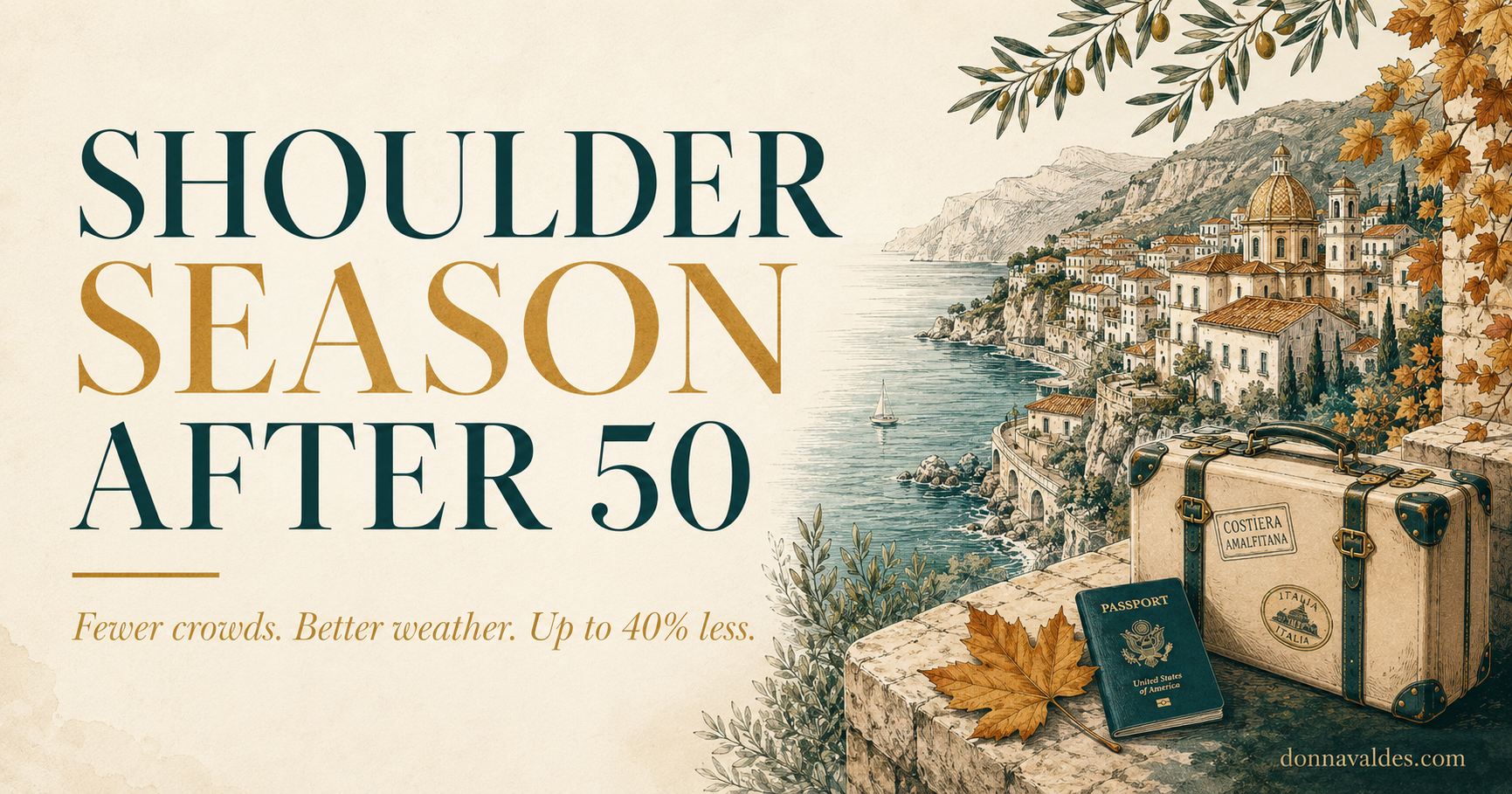
Shoulder Season Travel After 50: Why September and October Beat Summer (And How to Book It Cheaper)
Peak season travel is a young person's game.
Not because there's anything wrong with the destinations. But because peak season is designed around one specific traveler: someone chained to a school calendar, an employer's PTO window, or a partner's crushingly narrow vacation slot.
That's not us.
Once you're over 50, whether you're semi-retired, fully retired, self-employed, or just have more flexibility than you did at 35, you have access to one of the most valuable, least-talked-about advantages in travel.
Shoulder season.
I'm going to walk you through what it is, why it's the best-kept travel secret for anyone over 50, exactly where to go this fall, and how to book it 20 to 40 percent cheaper than what most people are paying for the same trip. Plus the tools I use to plan them.
Let's get into it.
What Shoulder Season Actually Is
Shoulder season is the travel window between peak and off season. For most popular destinations, it falls in the fall (September and October) and the spring (April and May).
The season sits in a specific sweet spot.
Peak season: Everything is expensive. Everything is crowded. Weather can be extreme (blazing summer heat or peak winter cold). Availability is limited. Prices are at their annual highest.
Off season: Prices drop way down. But many restaurants, tours, and even some hotels are closed. Weather can be miserable. You get the destination cheap, but a stripped-down version of it.
Shoulder season: Prices drop 20 to 40 percent from peak. Crowds are dramatically thinner. Weather is often better than in summer (cooler in hot destinations, warmer in cold ones). Every restaurant is still open. Every tour still runs. You get the full destination at a real discount.
For most of my life I traveled in peak season because that's when I had time. Now that I have flexibility, I've stopped. And I don't miss it at all.
Why Shoulder Season Exists (And Why Nobody Fixes It)
Here's the honest reason shoulder season is a bargain.
The travel industry runs on family and corporate calendars. Peak summer exists because kids are out of school and parents can take PTO. Peak winter and spring break exist because of holidays. When those windows close, demand drops. When demand drops, prices drop.
But most travelers are still locked into those same windows. So they overpay every year without questioning it.
The travel industry is not going to fix this for you. They love the pricing model they've built. Every hotel, every airline, every cruise line makes the majority of their annual revenue in a compressed number of weeks.
The only person who fixes it is the traveler who realizes they don't have to book inside the crush.
That's us.

The Over-50 Traveler Advantage
Here's the piece that most travel writers don't say out loud.
Anyone over 50 who has any flexibility has a competitive edge in travel that they aren't using.
You are not tied to school calendars. Even if you're helping with grandkids, most schedules can be worked around a Tuesday-to-Tuesday trip in mid-September.
You are not fighting for the same three weeks of PTO everyone in the office is claiming. Even if you're still working, you likely have more say in your calendar than a 32-year-old with two toddlers.
You are not paying a premium to travel when everyone else has to.
That flexibility is worth thousands of dollars a year. Literally. If you take one big trip a year, shifting it out of peak into shoulder can put $1,000 to $2,000 back in your pocket for the exact same trip.
Compound that over the next 20 years of travel and it's real money. Enough to fund an extra trip every couple of years. Just from timing.

The 5 Things You Save in Shoulder Season
Let me be specific about what you actually get back.
1. Money. On flights, hotels, tours, and cruises. 20 to 40 percent lower is normal. On some routes and properties, closer to 50 percent.
2. Crowds. The Louvre in July has a two-hour line. In October, it's 20 minutes. Rome in August is elbow to elbow. In late September, you can hear yourself think. Fushimi Inari in Kyoto in November is peaceful. In April cherry blossom season, it's a crush.
3. Weather. Most people don't realize that peak summer in the Mediterranean is uncomfortably hot for the type of walking-based travel most people over 50 want to do. Late September and early October in Italy, Greece, Croatia, and Portugal is often perfect: 70 to 78 degrees, blue skies, ocean still warm enough to swim.
4. Cancellation risk. According to travel industry data, cancellation concerns among older travelers have grown significantly, from 24 percent to 36 percent of respondents in the last year. Shoulder season reduces this risk because there's more availability if you need to rebook, and hurricane season and peak weather disruptions are less concentrated in these windows for most destinations.
5. Experience quality. Fewer people in each restaurant means better service. Tour guides who aren't burned out from peak season. Locals who are actually friendly again because they're not exhausted from three months of overtourism. This one is real and it's hard to describe until you experience it.
Where to Go This Fall 2026
Here are the shoulder season picks I'd send an over-50 traveler to right now.
The Mediterranean. Italy, Greece, Portugal, Croatia. Late September through October. Weather still gorgeous, water still swimmable, crowds gone, prices dropped. If you've been putting off Rome, Athens, Lisbon, or a Greek island trip, this is your window. Northern Italy (Milan, Lake Como, Venice) is especially magical in October.
Japan. Early autumn is one of the best times to visit Japan. The heat and humidity of summer has broken. Fall foliage begins in mid-October in the north and works its way down through November. Kyoto, Nikko, and the Japanese Alps are unreal. Book flights before mid-September for the best fares.
American Southwest national parks. Zion, Bryce, Arches, Grand Canyon, Sedona. September and October are ideal: cooler temperatures, fewer summer crowds, still-open trails, better light for photography. If you've been meaning to do a Southwest road trip, this is when it works.
Central European river cruises. Danube, Rhine, Douro. September through mid-October is peak river cruising season for a reason. Grape harvest, wine tastings, mild weather, and no summer heat. This one is popular so book early.
Coastal Croatia and Slovenia. Dubrovnik, Split, Ljubljana, Lake Bled. All at their best in September when summer crowds have thinned but water is still warm and skies are still clear.
New England fall foliage. Vermont, New Hampshire, Maine. Peak color usually falls in early to mid October depending on latitude. If you haven't done a leaf-peeping trip, put it on the list.

How to Actually Book It (Without Overpaying)
Here's the workflow I use for every shoulder season trip I book.
Step 1: Set a rough window. Not exact dates. A range. Something like "second half of September through mid-October." This flexibility is where the savings live.
Step 2: Use price alerts. Google Flights, Hopper, and Kayak all let you set alerts for specific routes over a date range. Set them 60 to 90 days before your target window. Watch the fares. Book when the alert says the price is at or near its low.
Step 3: Compare wholesale versus retail. Retail booking sites (Expedia, Booking.com, Kayak) are convenient but almost always more expensive than wholesale platforms. I use Travel Advantage as my wholesale platform because the rates are often 20 to 60 percent below what I'd see on retail sites for the same room in the same hotel. It's $20 to join as a customer. Even one trip usually pays for the membership 20 times over.
Step 4: Use AI to plan the daily itinerary. ChatGPT is genuinely excellent at building a realistic day-by-day itinerary once you tell it your dates, destinations, energy level, and interests. I use it as a starting draft, then refine. Saves hours of research and produces a better trip than most travel agents charge $200 to design.
Step 5: Book with a flexible cancellation policy. Given rising cancellation concerns, take the extra day of refundable window when you can. It's usually $30 to $75 extra and worth every dollar of peace of mind.
What NOT to Do
A few things I've learned the expensive way.
Don't book too close to peak edges. Late August and early November tend to still be pricey in many destinations because they overlap with holidays or extended peak windows. Aim for the middle of shoulder season for the sharpest prices.
Don't book everything in one platform. Comparing flights on one site, hotels on another, and cruises on a wholesale platform will almost always beat "all in one" bundles. Bundles look convenient but usually overcharge on hotels.
Don't ignore travel insurance for international trips over $3,000. For anyone over 50, medical evacuation coverage is worth the $80 to $150. Get it. Sleep better.
Don't skip the loyalty program even for a single trip. Every hotel chain and airline gives you enough for a free coffee, a free night eventually, or a lounge pass. Free money for signing up. Do it.
Real Numbers From a Real Trip
Here's what a typical shoulder season trip actually looks like versus peak.
Peak season trip to Italy in July for 7 days: Roundtrip flights around $1,400 per person. Mid-range hotel around $280 per night. Meals and activities around $150 per day per person. Total for a couple: around $6,760.
Same trip, same hotel, same restaurants, in mid-October: Flights around $850 per person. Hotel around $195 per night. Meals and activities the same. Total for a couple: around $4,860.
Savings: $1,900 for the exact same trip.
That $1,900 is either another trip next year, or the safety net that lets you book this one with less anxiety.
That's the math. It works.
FAQ
What is shoulder season travel?
Shoulder season is the travel window between peak and off season. For most popular destinations, it's September, October, April, and May. Prices are lower, crowds are thinner, and weather is often better than in peak summer or winter.
How much can I save in shoulder season?
Most travelers save 20 to 40 percent on flights and hotels versus peak. On a $5,000 vacation, that's $1,000 to $2,000 back in your pocket for the exact same experience.
Is fall a good time to visit Europe?
Yes. Late September through mid-October is one of the best travel windows for the Mediterranean, Central Europe, and the UK. Weather is mild, crowds are gone, prices drop after Labor Day.
What is Travel Advantage?
Travel Advantage is a membership platform that gives you wholesale rates on flights, hotels, cruises, and resorts. Members typically save 20 to 60 percent versus retail booking sites. It's $20 to join as a customer.
Do I need travel insurance for shoulder season trips?
For domestic trips, it's optional. For international trips over $3,000, especially anyone over 50, I recommend it. Medical evacuation coverage alone justifies the $80 to $150 cost.
What to Do Next
Grab the free money guide. The Over-50 Money Stretcher includes travel-savings tactics that pair perfectly with shoulder season booking. Free. Get it here.
Join Travel Advantage. $20 to join as a customer. Wholesale rates on the trips you'd already be booking. See how it works.
Interested in the business side of travel? If you're curious about how a travel-based business works and why I chose this category, here's the how-it-works page. Learn more.
The Bottom Line
You have paid full price for peak season travel your entire adult life.
You don't have to anymore.
Once you're over 50, you have the one thing peak season travelers don't have: flexibility. And that flexibility, used right, is worth thousands of dollars every year.
Book the fall trip. Skip the summer crush. Take the same trip for 30 percent less, with fewer people in every photo, and better weather when you get there.
Then take the money you saved and book next year's trip too.
That's how you turn your 50s, 60s, and 70s into the best travel decades of your life.
Donna


Explore more:





